
Advanced Prompt Engineering Techniques
Learn advanced prompting to guide AI reasoning and outputs
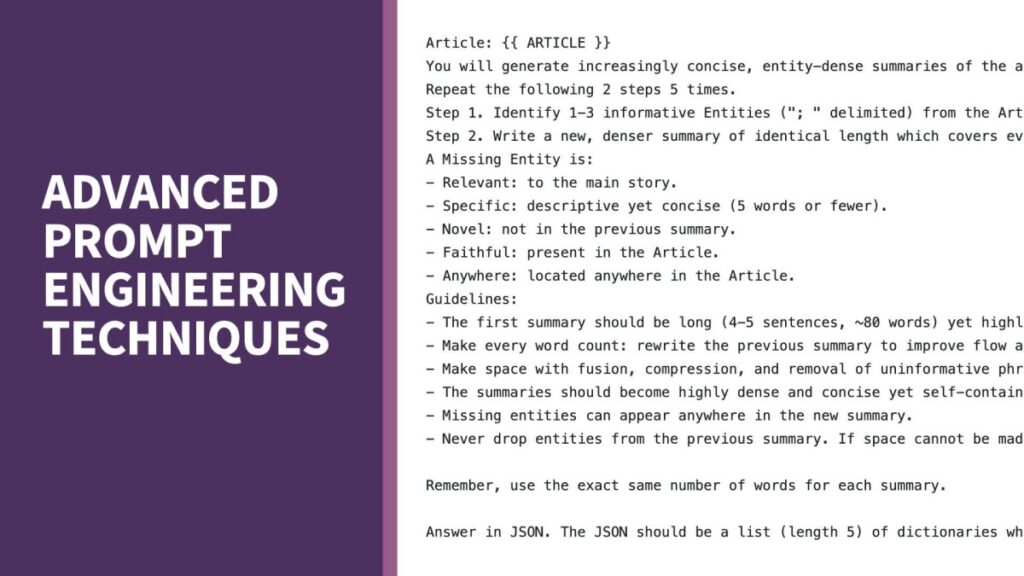
Advanced Prompt Engineering Techniques is a focused LinkedIn Learning course taught by Morten Rand‑Hendriksen that examines practical strategies for guiding generative AI toward more reliable, interpretable outputs.
It presents advanced prompt engineering patterns—including reference prompting, zero‑shot and few‑shot approaches, Chain‑of‑Thought and Tree‑of‑Thought methods, directional stimulus, and Chain‑of‑Density—to help practitioners design and evaluate better prompts. Learners can expect concise demonstrations, accompanying exercise files, and a short assessment that together support applying these techniques in development or product contexts.
At a Glance
Advanced Prompt Engineering Techniques, taught by Morten Rand-Hendriksen, is a focused course that explains advanced strategies for making generative AI systems more useful. It covers prompting patterns such as Chain-of-Thought and Tree-of-Thought and clarifies how and when to apply those strategies in AI-powered applications.
| Level | Advanced |
| Rating | 4.7 out of 5 |
| Duration | 1+ hours |
| Languages | English |
| Certificate | Certificate of Completion (downloadable and shareable) |
| Access | Access for as long as your LinkedIn Learning subscription is active; mobile app available for offline viewing |
| Course includes |
|
| Price | Subscription-based; included with LinkedIn Learning subscription (free trial available) |
What This Course Teaches
The course frames outcomes as measurable competencies so learners can apply advanced prompting patterns directly to AI development tasks and evaluate their effects on model behavior.
Learners finish able to design, implement, and compare prompting strategies such as Chain‑of‑Thought and Tree‑of‑Thought to improve reasoning, control, and output reliability.
How the Course Is Structured
The course is organized as an introductory section followed by a focused sequence of lessons on specific prompting techniques, totaling 11 short lessons (including a final quiz) and running for about 1 hour in total.
The syllabus delivers concise, single‑topic lessons so you can move quickly through individual techniques and reference specific examples as needed.
Curriculum overview
01 Prompting to make AI systems more useful ▾
Introduces the course and explains how effective prompting increases the usefulness of AI systems.
02 How to use the exercise files ▾
Explains how to access and work with the provided exercise files alongside the lessons.
03 Reference prompting ▾
Covers using external or embedded references to ground model outputs and reduce unsupported assertions.
04 Zero-shot and few-shot prompting ▾
Explains how to craft zero‑shot and few‑shot prompts to elicit desired task behavior without extensive fine‑tuning.
05 Chain-of-thought (Co — T) prompting ▾
Introduces Chain‑of‑Thought prompting to make model reasoning more explicit by guiding step‑by‑step solutions.
06 Take a deep breath and work step by step ▾
Demonstrates practical stepwise prompting patterns that break tasks into ordered subtasks.
07 Generated knowledge prompting ▾
Shows how to design prompts that surface, synthesize, or construct knowledge needed during a response.
08 Tree-of-thought (To — T) prompting ▾
Introduces Tree‑of‑Thought prompting to explore multiple reasoning branches and compare candidate solutions.
09 Directional stimulus prompting ▾
Covers using directional cues in prompts to steer tone, focus, and acceptable answer types.
10 Chain-of-density (Co — D) prompting ▾
Explores Chain‑of‑Density prompting as a way to regulate depth and concision across multi‑step replies.
11 Test your knowledge ▾
A short self‑check that quizzes key concepts covered in the lessons.
- 1 quiz
Audience & Requirements
The course is intended for practitioners who already understand basic prompting and want to adopt advanced strategies to improve AI reasoning and output control. It is best suited to people who plan to apply prompting techniques directly in development, product design, or research workflows.
- Prompt engineers and AI practitioners refining systematic prompting strategies.
- Software engineers integrating LLMs into applications who need more reliable outputs.
- Product managers and designers defining AI features and guardrails.
- Researchers or advanced users studying reasoning techniques like Chain‑of‑Thought and Tree‑of‑Thought.
- Familiarity with basic prompting concepts and common LLM behaviors.
- Comfort interpreting model outputs and iterating on prompt phrasing.
- Active LinkedIn Learning access to view the lesson videos and download exercise files.
- No special software or hardware beyond tools you normally use to prototype prompts.
Note: The course is labeled Advanced but is concise; expect a targeted overview rather than an exhaustive, hands‑on deep dive, so supplement with longer practical work if you need production‑grade mastery.
Final Verdict
This concise, concept‑focused course is worth taking if you are an experienced prompt engineer, developer, or product lead who needs a practical set of advanced prompting patterns to apply quickly. It delivers clear explanations of high‑value techniques and is efficient for time‑pressed professionals, but it is not a substitute for extended hands‑on practice or a comprehensive applied curriculum.
Given its strong rating and many learner reviews, plus a shareable completion certificate and inclusion with the platform subscription, it offers sensible value for subscribers seeking a targeted skills boost. If you need production‑grade, in‑depth training, plan to pair this overview with longer practical projects or specialist workshops.


 Codecademy
 FutureLearn
  DataCamp