Learning Video Lighting
Learn to shape light for flattering on-camera portraits
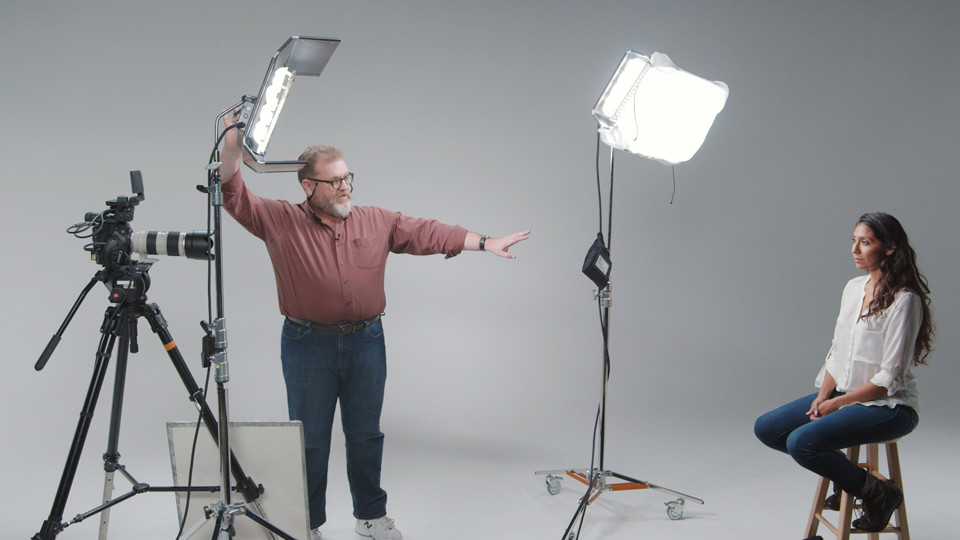
Learning Video Lighting is a practical online course taught by Mark W. Gray that focuses on portrait and location lighting for video production.
It emphasizes controlling available light, adding supplemental sources, and understanding core concepts such as three-point lighting, hard versus soft light, lighting angle, intensity, and color temperature, and demonstrates both professional and budget-friendly gear so learners can apply setups on real shoots. Students should come away able to set up and adjust lighting to improve on-camera appearance across common shooting scenarios.
At a Glance
Learning Video Lighting is a concise course taught by Mark W. Gray that introduces practical approaches to portrait and location lighting for video production.
It covers foundational concepts such as three-point lighting, the visual effects of hard versus soft light, and practical strategies for using both professional and DIY gear to improve how subjects appear on camera.
| Level | Beginner |
| Rating | 4.8 out of 5 |
| Duration | 1+ hours |
| Languages | English |
| Certificate | Certificate of completion |
| Access | Access while your LinkedIn Learning subscription is active |
| Course includes |
|
| Price | Subscription-based (monthly or annual plans); free trial available |
What This Course Teaches
Outcomes are presented as actionable skills you can use on real shoots rather than abstract concepts, focusing on portrait and location scenarios learners commonly encounter.
Students who complete the course will be able to apply reliable lighting techniques, adjust color and intensity, and implement practical gear and setup choices to control how subjects appear on camera.
How the Course Is Structured
The course is organized as a sequence of short, focused lessons grouped into five top-level sections: an introductory welcome, three themed units covering fundamentals, faces, and real-world scenarios, and a brief conclusion, with a total of 19 lessons listed in the syllabus.
Total runtime across all lessons is about 1 hour 27 minutes.
Curriculum overview
01Welcome▾
Brief course welcome and overview of objectives.
02History of lighting▾
Survey of historical developments that shaped modern lighting practices.
03The whys of lighting▾
Explains why lighting matters for visual storytelling and subject portrayal.
04Understanding hard vs. soft light▾
Compares characteristics and visual effects of hard and soft light.
05Color temperature▾
Covers how color temperature affects mood and how to balance mixed light.
06The basic lighting kit▾
Introduces common lighting gear and essential equipment for portrait work.
07Kit accessories and lighting modifiers▾
Demonstrates modifiers and accessories that shape and control light quality.
08Lighting with DIY and store-bought equipment▾
Shows affordable and DIY options for achieving usable lighting on a budget.
09Understanding lighting angles▾
Explains how angle of light sculpts form and affects facial features.
10Utilizing hard vs. soft light▾
Applies hard and soft lighting choices to faces and explains when to use each.
11The importance of eye light▾
Covers techniques for adding catchlights to enhance subject presence.
12Controlling shadows with fill light▾
Shows how to use fill light to manage shadow depth and contrast.
13Creating depth with backlight▾
Demonstrates backlighting to separate subject and add dimensionality.
14The importance of the setting▾
Discusses how location and background influence lighting decisions.
15Shooting inside with artificial light▾
Provides strategies for controlling artificial light when shooting indoors.
16Shooting inside with natural light▾
Explains how to use available daylight to light interior scenes.
17Shooting outside in direct sunlight▾
Addresses techniques for managing harsh outdoor sunlight and contrast.
18Shooting outside later in the day▾
Covers low-angle light and golden-hour strategies for flattering outdoor portraits.
19Next steps▾
Wrap-up with recommended next steps and resources for continued practice.
Audience & Requirements
This course is aimed at beginner-level creators who want practical, shoot-ready lighting skills rather than theoretical depth.
It is well suited to hobbyist and entry-level videographers, photographers adding motion work, freelance/event shooters, and online content creators who need reliable portrait and location lighting techniques.
- Beginner videographers and online content creators improving on-camera appearance.
- Photographers transitioning into video and learning motion lighting.
- Freelance or event shooters who need portable, practical lighting strategies.
- Hobbyist filmmakers seeking affordable, do-it-yourself lighting solutions.
- No special prerequisites; the course is designed for beginners.
- A camera or smartphone with basic manual or semi-manual exposure controls for hands-on practice.
- Familiarity with basic camera settings (ISO, shutter, aperture) is helpful but not required.
- Optional lighting gear or household alternatives (reflectors, lamps, clamps) to replicate demonstrated setups.
Final Verdict
The course delivers focused, example-driven instruction and practical demonstrations that make core portrait and location lighting techniques immediately usable.
For beginner and early-career creators who need immediate, practical lighting skills, this course is a worthwhile, low-friction investment.
Its strong rating, large learner base, and a shareable completion certificate increase its practical value, particularly for learners who already have or plan to keep the platform subscription.
Those seeking advanced, theory-heavy lighting training may find the material introductory; treat this as a pragmatic course to improve on-camera results quickly rather than a comprehensive professional certification path.

 Skillshare