
Intro To Public Speaking: Give A 5 Minute Talk Without Dying
Prepare and deliver a confident five‑minute talk with visuals
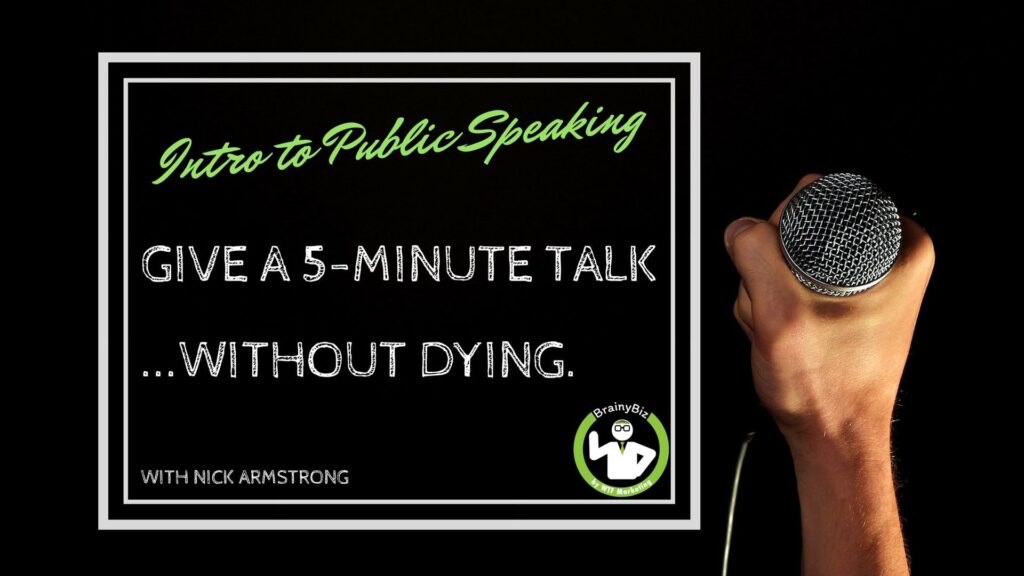
Intro To Public Speaking: Give A five‑minute Talk Without Dying is a practical, project‑driven class that teaches a compact method for planning, designing, and rehearsing short, high‑impact presentations for live or recorded delivery. It emphasizes clear topic selection, a compact outline, image‑led slide design, and targeted rehearsal to build usable speaking confidence.
Learners work through a hands‑on project that produces a ready‑to‑present outline and visual slide deck while using self‑recording and iterative practice to identify and reduce verbal and physical tics. The course is aimed at beginners and occasional presenters who want a repeatable workflow to prepare and deliver a confident five‑minute talk.
At a Glance
Intro To Public Speaking: Give A 5 Minute Talk Without Dying is a Skillshare class taught by Nick Armstrong that guides beginners through planning and presenting a concise, high-impact talk.
It walks learners through topic selection, a compact outlining method, slide-deck design, identifying delivery tics, and a hands-on project that produces a finished outline and slides.
| Level | Beginner |
| Rating | 4.6 out of 5 |
| Duration | 30+ minutes |
| Languages |
|
| Certificate | No certificate |
| Access | Access for as long as your subscription is active |
| Course includes |
|
| Price | Included with subscription |
What This Course Teaches
The course frames outcomes as measurable competencies you can use immediately: structuring a concise five‑minute talk, designing an image‑led slide deck, and eliminating distracting delivery tics through focused practice. Students finish able to build a complete outline, create a 20‑slide visual deck, and apply self‑recording techniques to refine their delivery.
How the Course Is Structured
The class is organized as a compact sequence of eight short lessons that move from orientation through a step‑by‑step hands‑on project covering topic selection, compact outlining, image selection, slide assembly, and practice workflows.
Total runtime is about 30 minutes of video across eight lessons/sections.
Curriculum overview
01Introduction▾
Quick orientation to course goals, format, and the hands‑on project you will complete.
02Meet Your Teacher▾
Instructor background, teaching approach, and examples of the kinds of short talks the course models.
03Class Project Overview▾
Walkthrough of the multi‑step project you will follow to produce a five‑minute talk and slide deck.
- Complete the two‑page planning guide
04Pick a Topic You Can Cover in 5 Minutes▾
Guidance and examples to help you choose a narrow, audience‑appropriate topic for a concise talk.
- Part 1: Pick and document your five‑minute topic
05Outline the Topic in 20 Tweets▾
A stepwise method that uses tweet‑length prompts to create a tight, logical outline for your talk.
- Part 2: Draft an outline using 20 tweet‑length points
06Find 20 Images and Build Your Deck▾
How to source free‑to‑use images and assemble a 20‑slide visual deck that supports, not overwhelms, your talk.
- Part 3: Collect 20 images and create a slide deck (HaikuDeck recommended)
07Record Yourself Practicing▾
Techniques for recording rehearsals, spotting verbal/physical tics, and iterating on delivery.
- Part 4: Record practice sessions and document tics to correct
08Final Practice, Upload, and Next Steps▾
Final rehearsal guidance, tips for sharing your talk publicly, and suggested next steps for continued improvement.
- Part 5: Practice, record your first five‑minute talk, and upload/share (e.g., YouTube)
Audience & Requirements
This class targets beginners and occasional presenters who need a short, image‑driven five‑minute talk rather than a long-form lecture.
It’s well suited to new speakers, entrepreneurs preparing concise pitches, community‑event presenters (Ignite/TEDx style), and professionals who must deliver focused status updates or lightning talks.
- New or anxious speakers preparing a first five‑minute talk.
- Entrepreneurs and founders crafting short pitches or launch intros.
- Community‑event presenters (Ignite, TEDx, local meetups) developing lightning talks.
- Professionals needing concise status updates or conference lightning talks.
- No prior public‑speaking experience required.
- Willingness to practice and self‑record for several hours to refine delivery.
- Access to a slide‑creation tool (HaikuDeck recommended) and ability to source free images (Pixabay/Creative Commons).
- A phone or webcam capable of recording rehearsal videos and uploading them (e.g., YouTube) for review and sharing.
Final Verdict
This is a concise, practice‑first primer that reliably teaches a repeatable method for planning, visualizing, and rehearsing a five‑minute talk.
Given its strong user rating and availability on a subscription platform, it represents good practical value for learners who want rapid, hands‑on improvement rather than academic depth or formal credentials.
Recommended for beginners, entrepreneurs, and community presenters who need a quick, repeatable workflow to produce a short talk; not the best choice for learners seeking accredited certification or advanced rhetorical theory.


 LinkedIn Learning