Electronics Foundations: Basic Circuits
Learn to build and test basic electronic circuits
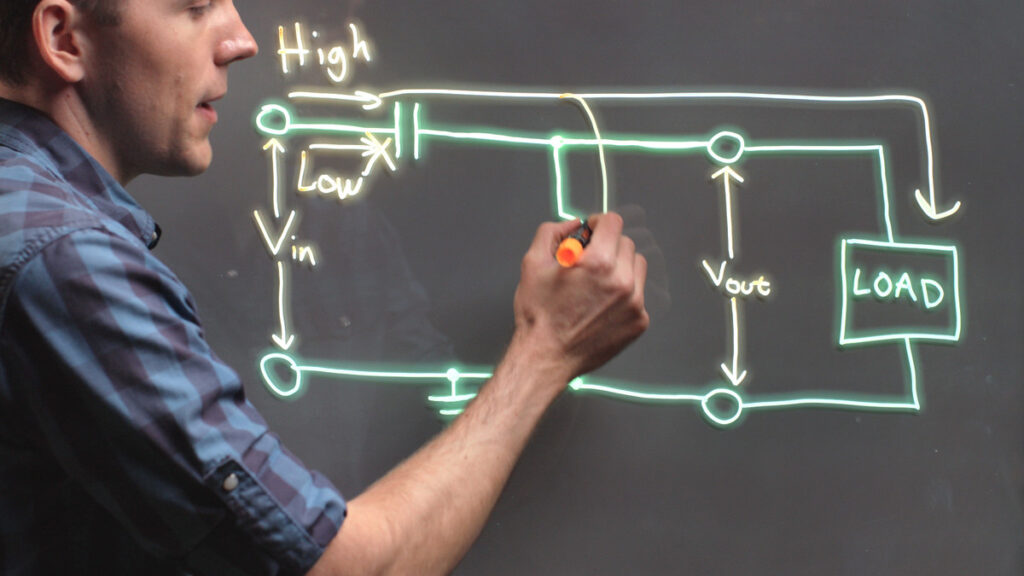
Electronics Foundations: Basic Circuits is an introductory course taught by electrical engineer Barron Stone that explains how common components behave and how to use them together in working circuits. The curriculum emphasizes practical skills—reading schematics, assembling breadboard circuits, and distinguishing alternating and direct current—while introducing components such as resistors, capacitors, and inductors alongside measurement tools like the oscilloscope.
Students work toward measurable competencies: assembling and testing simple circuits, using an oscilloscope to capture and interpret waveforms, and designing basic passive filters to shape signal frequencies. The course blends circuit design concepts, hands-on measurement techniques, and short practice challenges so learners can apply electronics fundamentals in lab or hobby projects with clearer diagnostic and analytical skills.
At a Glance
Electronics Foundations: Basic Circuits is an introductory online course that explains how common electrical components behave and how they are used together in simple circuits.
Barron Stone, an electrical engineer and instructor, demonstrates building and measuring circuits while covering resistors, capacitors, inductors, oscilloscope use, alternating versus direct current, and passive filter design.
| Level | Beginner |
| Rating | 4.8 out of 5 |
| Duration | 4+ hours |
| Languages | English |
| Certificate | Certificate of completion (shareable) |
| Access | Access while subscription is active (LinkedIn Learning) |
| Course includes |
|
| Price | Included with LinkedIn Learning subscription (monthly or annual plans) |
What This Course Teaches
This course frames outcomes as concrete, measurable competencies so learners can assemble, test, and analyze simple electronic circuits using standard tools and methods. Students will finish able to build breadboard circuits, measure signals with an oscilloscope, explain component behavior, and design basic passive filters.
How the Course Is Structured
The course is organized into 11 sections that group lessons into focused modules covering fundamentals, component-focused units, measurement techniques, and reactive-element topics.
Overall the syllabus lists 11 top-level modules and totals roughly 4+ hours of video content.
Curriculum overview
01 Introduction ▾
Orientation material covering course scope, prerequisites, exercise files, and basic safety guidance.
02 1. Building Circuits ▾
Practical techniques for reading schematics and assembling circuits on a breadboard.
03 2. Resistors ▾
Overview of resistor types, characteristics, value reading, and measurement techniques.
04 3. Resistive Circuits ▾
Analysis of series/parallel networks, voltage dividers, potentiometers, Kirchhoff’s laws, and measurement strategies.
- Challenge: Light activated switch
- Solution: Challenge: Light activated switch
05 4. Oscilloscope Measurements ▾
How oscilloscopes display signals and how to measure and adjust display and trigger settings for accurate readings.
06 5. Capacitors ▾
Capacitor types, reading values, series/parallel behavior, and RC circuit fundamentals.
- Challenge: Camera flash
- Solution: Camera flash
07 6. Alternating Current ▾
Comparison of alternating and direct current, sine-wave properties, and methods for measuring AC voltage.
08 7. Electrical Signals ▾
Introduces frequency-domain concepts, bandwidth, square-wave behavior, and common signal sources.
09 8. Reactive Circuits ▾
Impedance, filter frequency response, decibels/logarithmic scales, and design of RC low-pass and high-pass filters.
- Challenge: Filter audio
- Solution: Filter audio
10 9. Inductors ▾
Properties and types of inductors, L/R transient responses, and comparison of inductors versus capacitors.
11 Conclusion ▾
Final reflections and suggested next steps for continuing electronics study.
Audience & Requirements
This course targets beginners and early learners who want a practical, hands-on introduction to everyday circuit building and measurement techniques. It is well suited to hobbyists, students, and technicians seeking a compact, application-focused grounding in basic circuits and instrumentation.
- Beginners learning core electronics concepts and practical skills.
- Hobbyists and makers who want to build and test simple circuits.
- Students preparing for introductory lab work in electronics or electrical engineering.
- Technicians and engineers seeking a quick refresher on measurement and passive components.
- No special prerequisites beyond basic arithmetic/algebra.
- A basic electronics kit for hands-on practice (breadboard, resistors, capacitors, inductors, potentiometers).
- A multimeter; access to an oscilloscope or a simulation tool to follow measurement demonstrations.
- Willingness to work through short practice challenges and quizzes.
Final Verdict
This course is a practical, cost-effective introduction for beginners, hobbyists, and students who need hands-on exposure to assembling and measuring simple circuits. Given its strong learner feedback and broad reach, it’s a dependable short course to gain usable skills and a shareable completion credential.
It is not a substitute for an extended lab sequence or advanced analog-design study, so treat it as a compact stepping stone that makes subsequent, deeper courses easier to follow. If you already use the platform subscription the course represents good value for quick upskilling; if not, weigh the subscription model against how much guided, introductory lab practice you need.


 Pluralsight
 Skillshare
 Codecademy